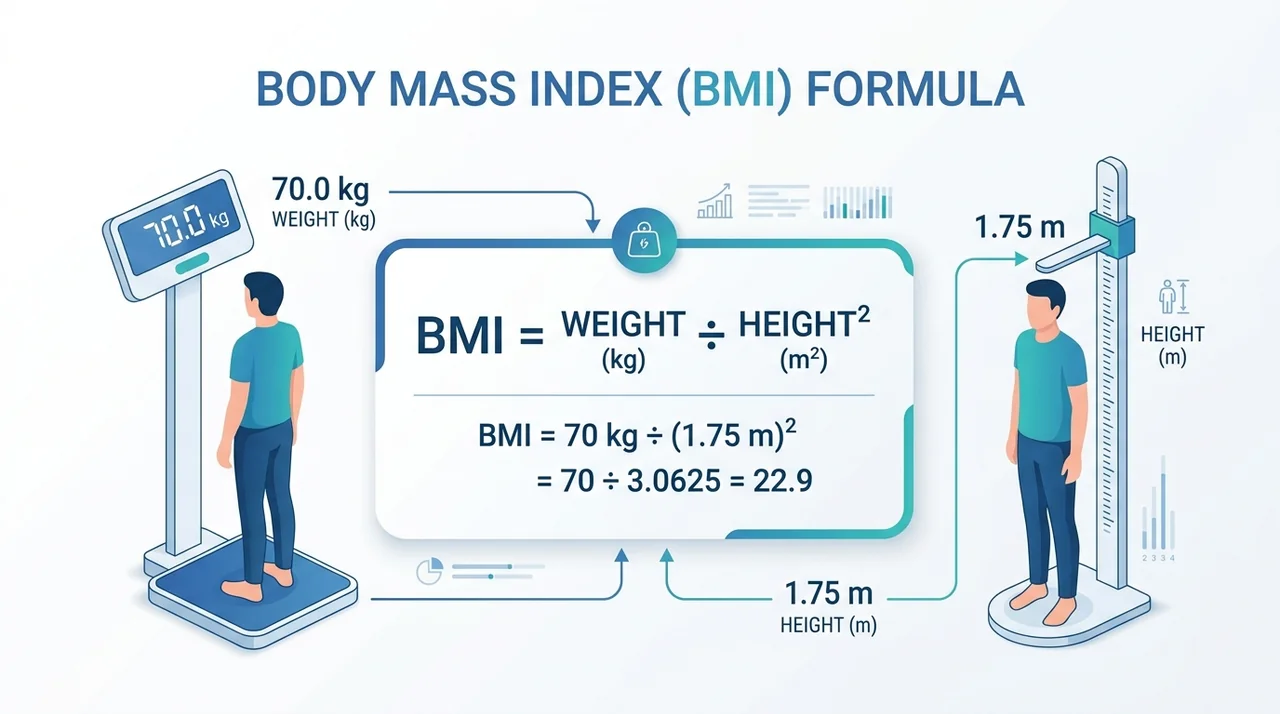
What Is BMI and How Is It Calculated?
Body Mass Index — commonly called BMI — is a number calculated from a person's height and weight. It is used worldwide as a quick screening measure to identify adults who may be underweight, at a healthy weight, overweight, or obese.
Try it now: Use the BMI Calculator to instantly calculate your BMI in kg/cm or lbs/ft.
Disclaimer: BMI is a screening tool, not a medical diagnosis. It does not measure body fat directly and does not account for muscle mass, bone density, age, or ethnicity. Always consult a healthcare professional for personal health advice.
The BMI Formula
BMI is calculated with a simple formula using only two values: weight and height.
Metric Formula (kg and cm)
BMI = weight (kg) ÷ height² (m²)
Example: A person weighing 70 kg who is 1.75 m (175 cm) tall.
BMI = 70 ÷ (1.75 × 1.75)
BMI = 70 ÷ 3.0625
BMI = 22.9
This places them in the normal weight category.
Imperial Formula (pounds and inches)
BMI = (weight (lbs) ÷ height² (in²)) × 703
Example: A person weighing 154 lbs who is 5 feet 7 inches (67 inches) tall.
BMI = (154 ÷ (67 × 67)) × 703
BMI = (154 ÷ 4489) × 703
BMI = 24.1
Also in the normal weight range.
BMI Categories for Adults
| BMI Range | Category | |--------------|---------------------| | Below 18.5 | Underweight | | 18.5 – 24.9 | Normal weight | | 25.0 – 29.9 | Overweight | | 30.0 – 34.9 | Obese (Class I) | | 35.0 – 39.9 | Obese (Class II) | | 40.0 and above | Obese (Class III) |
These ranges are established by the World Health Organization (WHO) for adults aged 20 and older.
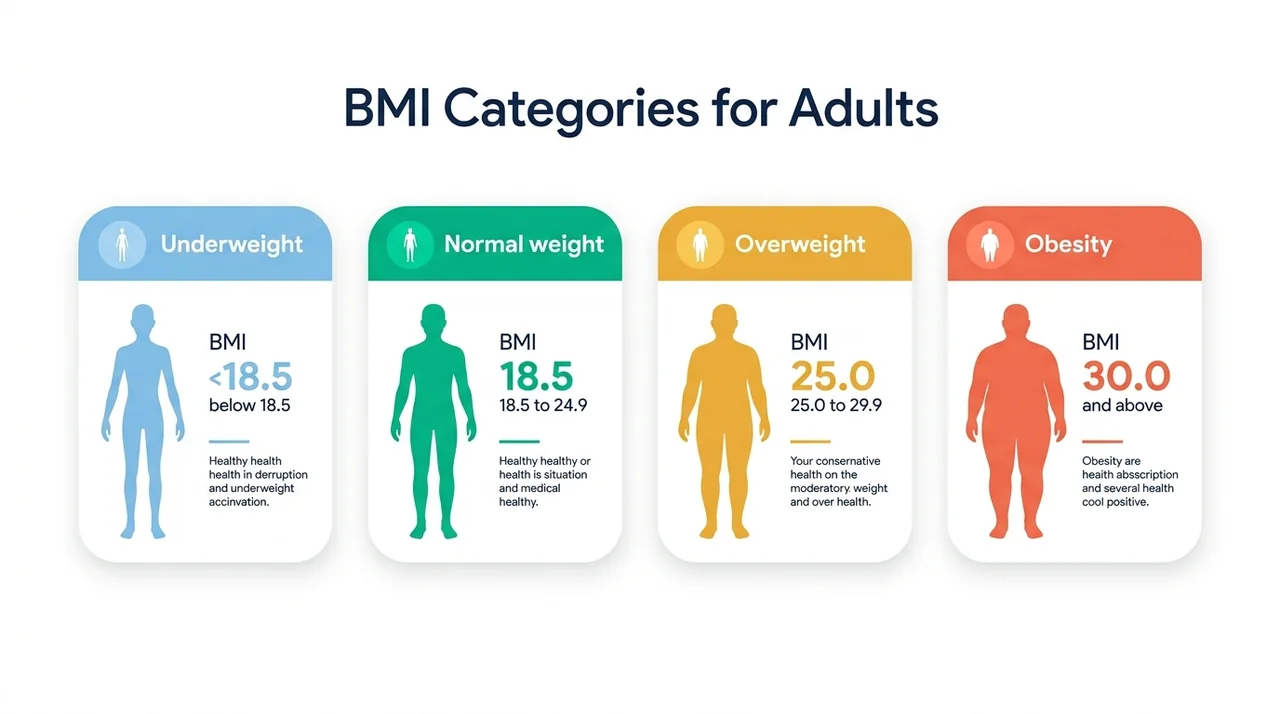 BMI Categories Chart for Adults showing underweight, normal, overweight, and obese ranges
What Does Your BMI Mean?
A BMI number tells you which weight category you fall into relative to your height. However, it does not tell the full story of your health:
- Athletes often have high BMI due to muscle mass, even with low body fat
- Older adults may have higher body fat at the same BMI as younger people
- Ethnicity can affect risk thresholds — some populations face higher risks at lower BMI values
BMI is useful for assessing trends across large populations, but individual health assessments require more than a single number.
Healthy Weight Range
For a given height, the healthy weight range corresponds to BMI 18.5–24.9.
For someone who is 170 cm (5′7″) tall:
Metric:   18.5 × (1.70)² = 53.5 kg  to  24.9 × (1.70)² = 71.9 kg
Imperial: 53.5 × 2.205 ≈ 118 lbs   to  71.9 × 2.205 ≈ 159 lbs
The BMI Calculator shows this range automatically once you enter your height.
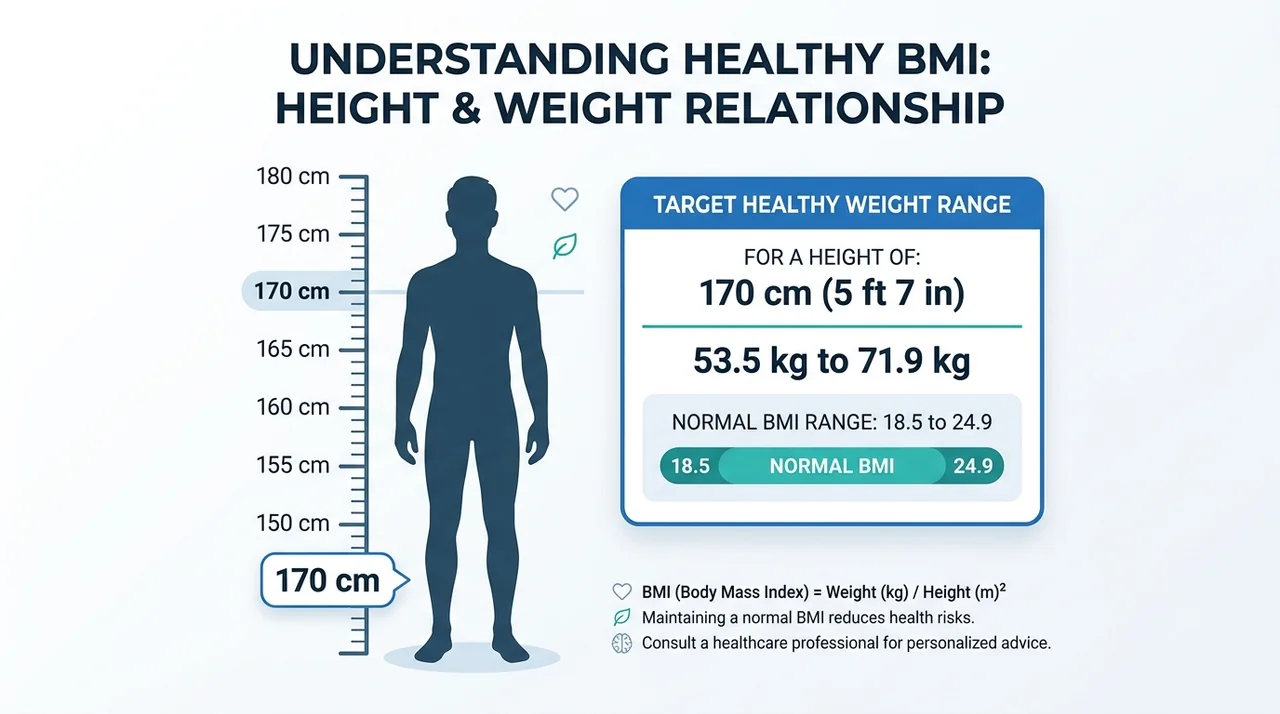 Healthy weight range by height infographic
Common Questions
Is BMI the same for men and women? The mathematical formula is identical for all adults. However, clinicians may interpret results differently based on sex, age, and other health factors.
How accurate is BMI? BMI correlates reasonably well with body fat at the population level. For individuals — especially athletes, the elderly, and pregnant women — it is less reliable as a standalone measure.
What is a good BMI for adults? For most adults, 18.5 to 24.9 is considered the healthy range. Whether your specific BMI is healthy depends on many other factors that a doctor can assess.
Calculate Your BMI Now
The BMI Calculator supports metric and imperial units, shows your category, and displays the healthy weight range for your height — instantly in your browser, with no data sent to any server.
Related Tools
- Discount Calculator — Calculate sale prices and savings
- Percentage Calculator — Find percentages and ratios
- Age Calculator — Calculate exact age from a date